Publication
12 December 2025
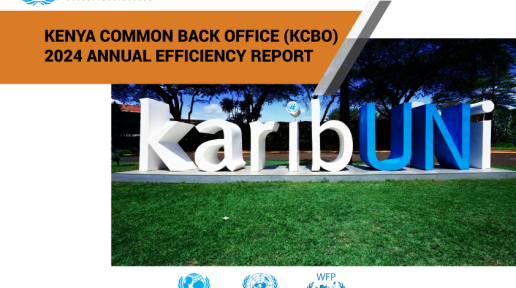
2025 Mid-Year Kenya Common Back Office (KCBO) Report,
The United Nations in Kenya has reached an important milestone in strengthening shared operational services through the Kenya Common Back Office. The 2025 Mid-Year KCBO Report shows a system that has moved from initial establishment to consolidation, delivering results in a context of rising operational demand and tightening financial spaceNow supporting 97 UN offices across the country, the KCBO has achieved full subscription, with all UN entities operating in Kenya signing Service Level Agreements. This marks a decisive shift towards a more integrated operating model that reduces duplication and allows agencies to rely on common systems for human resources, procurement, ICT, administration, logistics and finance. The expansion since 2024 reflects both the arrival of new regional and global UN offices in Kenya and growing confidence in shared service delivery.Service demand continues to increase. By mid-2025, the KCBO was delivering 82 services across the system, with UNON acting as the primary provider and UNICEF and WFP complementing delivery in finance and logistics. While uptake varies by service line, there is clear evidence that agencies are increasingly testing and adopting KCBO services as part of their operational planning. This gradual shift signals a maturing model in which shared services are becoming standard practice rather than an optional arrangement.Digital transformation remains central to KCBO’s progress. The Kenya Service Hub has evolved into a single entry point for administrative services, allowing staff across agencies to submit requests, track progress and provide feedback through one integrated platform. Alongside the Client Billing Centre and performance dashboards, these tools have strengthened transparency and reduced administrative friction, particularly following the transition from quarterly to annual billing cycles.Infrastructure investments have also delivered visible gains. The relocation of core administrative services into newly constructed office buildings at the UN Gigiri campus has improved accessibility and reinforced the one-stop-shop model envisioned for KCBO. These facilities were designed with sustainability and staff wellbeing in mind, while parallel upgrades to ICT infrastructure have enhanced network resilience and service continuity as digital dependence across the UN system grows.Client engagement remains a cornerstone of the KCBO approach. Structured governance bodies, targeted engagement sessions and continuous feedback mechanisms have helped maintain dialogue with UN entities, even as financial pressures affect service demand and billing timelines. Client satisfaction surveys point to steady improvements in responsiveness and clarity, while also identifying areas requiring further refinement.The operating environment remains challenging. Budget cuts and global funding constraints continue to affect many UN entities, slowing service transitions and placing pressure on cost recovery. At the same time, the UN80 initiative has reinforced the importance of shared services as a strategic response to reform, efficiency and accountability. Within this context, the KCBO continues to adapt, balancing flexibility with the need to sustain service quality and financial viability.As the year progresses, the Kenya Common Back Office will focus on deepening service uptake, strengthening cost-efficiency measures and aligning closely with evolving UN reform processes. The mid-year findings point to a clear conclusion: shared services are no longer a back-office experiment, but a core enabler of a more agile, coordinated and effective United Nations in Kenya.Read the full Kenya Common Back Office Mid-Year Report 2025 for detailed data, analysis and next steps